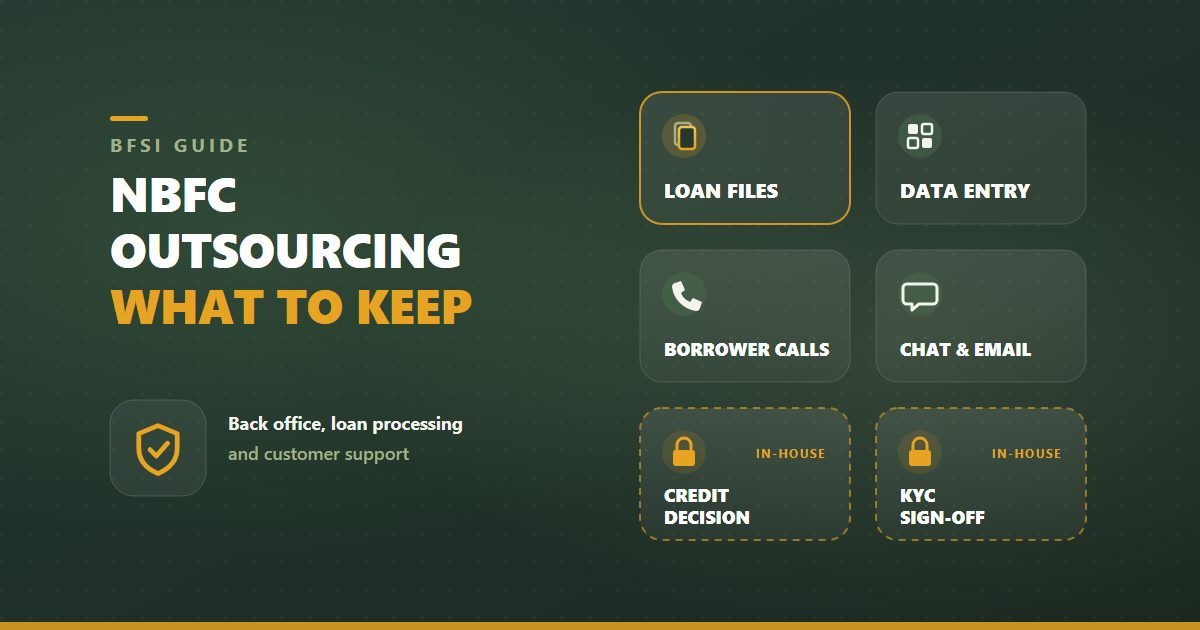
NBFC outsourcing means handing defined, repeatable work, such as loan file preparation, document processing, data entry and customer support, to a specialist partner. Under RBI's 2025 outsourcing directions, an NBFC may not outsource core management functions: internal audit, strategy, compliance, loan sanction or determining KYC compliance. The NBFC stays responsible for everything its partner does.
That boundary is the most useful thing to understand before you speak to any BPO. Non-banking financial companies (NBFCs) need application backlogs cleared and borrowers answered quickly, and regulators expect every file and interaction to stand up to scrutiny. This guide explains what NBFCs typically outsource, what the Reserve Bank of India's current directions actually say, how to set up loan processing and customer support with a partner, and the questions to ask before you sign. For a wider view of the sector, see our BFSI outsourcing page and the segments we serve.
1. What NBFCs Outsource, and What They Keep
RBI's outsourcing directions for NBFCs give a useful list of the financial services an NBFC may outsource: applications processing (loan origination and credit cards), document processing, marketing and research, supervision of loans, data processing and back-office related activities (RBI, Managing Risks in Outsourcing Directions, 2025, paragraph 4). The same directions define outsourcing as using a third party to perform, on a continuing basis, activities the NBFC would normally do itself; a contract for a limited period still counts.
In practice, the work NBFCs hand to a BPO falls into three groups. The table below sets out each one alongside the decision that has to stay with the lender.
| Area | What a partner can do | What stays with the NBFC |
|---|---|---|
| Loan processing | Collect documents, check files are complete, extract figures from statements, enter data, compile the file for the underwriter | Credit assessment and the decision to sanction the loan |
| Back office | Data entry and record updates, data cleansing, document indexing, reconciliation support, reporting | Compliance sign-off, internal audit and policy |
| Customer support | Answer calls, chats, emails and WhatsApp messages on application status, EMIs, statements and account queries | Grievance redressal policy, product terms and any financial advice |
| KYC | Help applicants understand which documents to submit | Determining whether a customer meets KYC norms |
The pattern is consistent: a partner can do the preparation, processing and communication around a decision, while the NBFC makes the decision. Our in-house vs outsourced underwriting comparison looks at the same line from the underwriting desk's point of view.
2. What RBI's Outsourcing Directions Say
The current rules are the Reserve Bank of India (Non-Banking Financial Companies – Managing Risks in Outsourcing) Directions, 2025, issued on November 28, 2025. They repealed the earlier NBFC instructions on outsourcing of financial and IT services and consolidated them in one document (paragraph 100). Six provisions matter most when you plan an outsourcing programme. This is a plain-English summary, not legal advice; read the directions with your compliance team.
Core management functions cannot be outsourced (para 15)
An NBFC shall not outsource internal audit, strategic and compliance functions, or decision-making functions such as determining compliance with KYC norms for opening deposit accounts, giving sanction for loans (including retail loans) and managing the investment portfolio. NBFCs in a group or conglomerate may outsource these within the group, subject to further conditions, and internal auditors may be on contract.
Responsibility stays with the NBFC (paras 9 and 17)
Outsourcing does not diminish the obligations of the NBFC, its Board and senior management. The NBFC is responsible for the actions of its service providers, including direct sales agents and recovery agents, and for the confidentiality of customer information they hold. It must retain ultimate control of the outsourced activity.
No prior approval, but full supervision (para 16)
An NBFC does not need RBI's prior approval to outsource financial services, but the arrangements are subject to on-site and off-site monitoring and inspection by RBI.
A Board-approved policy and a central record (paras 20 and 36)
The NBFC needs a Board-approved outsourcing policy covering how activities and providers are selected, delegation of authority and monitoring. It must keep a central record of all material outsourcing, with half-yearly reviews placed before the Board or Risk Management Committee.
Need-to-know access to customer data (paras 23 to 25)
The service provider's access to customer information must be limited to what is required to perform the outsourced function, and the NBFC must monitor the provider's security practices regularly and require it to disclose security breaches.
Customers keep their rights against the NBFC (paras 54 to 56)
Outsourcing does not affect customers' rights against the NBFC, including their access to redressal. Where customers deal with a service provider, the NBFC must say in its product literature that a service provider may be used, and it must run a robust grievance redressal mechanism.
Materiality decides how much governance applies
The governance requirements apply to material outsourcing: an arrangement which, if disrupted, could significantly affect the NBFC's business operations, reputation, profitability or customer service (paragraph 14). One of the listed tests is the significance of the activity for customer service, so in our view a borrower-facing helpdesk should be planned as material.
What the outsourcing agreement must contain
Paragraph 34 lists key provisions, including service and performance standards, the NBFC's access to records held by the provider, prior consent before subcontracting, confidentiality controls and liability for a breach, business continuity plans, audit rights, RBI's right to inspect the provider, and a termination clause. A partner used to regulated work will expect these clauses.
Design the process around the decision point
Before scoping any outsourced workflow, mark the exact step where an NBFC employee makes a decision: sanction, KYC compliance, a waiver, a complaint outcome. Everything before that step can be prepared by the partner; the step itself, and the sign-off, stays in your system under your staff's login.
3. Loan Processing Outsourcing for NBFCs
Loan processing outsourcing for an NBFC is the back-office work that turns an application into a file an underwriter can assess. Underwriters lose time when files arrive incomplete, unreadable or out of order; a dedicated processing team sits in front of the underwriting desk and removes that friction. A typical workflow looks like this:
Application intake
New applications arrive in your loan management system or CRM. The processing team picks them up from a queue inside your system, not from email attachments or shared drives.
Document collection
The team requests and tracks every document your checklist requires, including follow-up calls that help applicants complete their submissions.
Completeness and consistency checks
Documents are checked against your checklist for presence, legibility and consistency between fields, with every check recorded. Discrepancies are flagged rather than resolved by judgement.
Data extraction and entry
Figures from bank statements and financial statements are keyed into your lending system or templates, with double-key checks or OCR-assisted capture that a person verifies.
File hand-off with exception notes
The complete file moves to your underwriting queue with missing items and discrepancies noted, so your underwriter starts on assessment instead of assembly.
Decision by your underwriter
Your credit team assesses the file and makes the sanction decision. The partner never approves, rejects or prices a loan.
Where KYC fits
Know Your Customer (KYC) is the area NBFCs most often ask about. RBI's directions name "determining compliance with KYC norms for opening deposit accounts" as a decision-making function that cannot be outsourced, and many NBFCs apply the same principle to every KYC decision as a matter of policy. In our view, the safest design keeps the KYC determination, and the people and systems that make it, entirely inside the NBFC. A processing partner can help applicants understand which documents to send and can make sure a file is complete before it reaches your KYC team, but it should not be the party that decides a customer is compliant. Infusion BI's pods work on the preparation side of that line: document completeness checks against your checklist, with the compliance decision left to your team.
See our loan underwriting support service for how a dedicated file-preparation pod is staffed, and the wider Data Operations and back-office service for data entry, cleansing and record management.
4. Customer Support Outsourcing for NBFCs
Borrowers contact an NBFC throughout the life of a loan: to check an application, ask about an EMI date, request a statement or update contact details. These contacts are repetitive enough to be documented, which makes them suitable for a well-run outsourced team.
Inbound voice
Application status, EMI schedules, statement and certificate requests, account updates, and routing to your teams.
Chat, email and WhatsApp
Written queries answered from your approved knowledge base, logged against one customer record in your helpdesk.
Outbound service calls
Reminders to complete an application, document follow-ups and welcome calls to existing customers, made from the right number series.
Escalation to your staff
Complaints, waiver requests and anything needing a decision are escalated to the NBFC team that owns it, with the context attached.
Calling rules for NBFC service calls
Outbound calls from a lender now follow designated number series. In a July 10, 2026 clarification, TRAI stated that it has mandated 1600xx series numbers for service and transaction calls by BFSI entities regulated by RBI, SEBI, IRDAI and PFRDA to their existing customers, and that tagging, blocking or filtering of 1600 series calls is not permitted. Promotional calls by entities of any sector must use 140xx series numbers, and customers can block them by sector on the Do Not Disturb (DND) registry. Your outsourced team must call from the series that matches the purpose of each call, and promotional lists must be filtered against DND preferences.
Boundaries to write into the SOW
- No financial advice. Agents explain process and status; they do not advise a borrower on which product to choose.
- No decisions. Waivers, restructuring, complaint outcomes and credit decisions are escalated to your staff.
- Payments inside your systems only. Where a programme includes taking card payments, agents take them only inside your own payment systems and never record card data anywhere else.
- Clear grievance routing. Every complaint is logged in your system and follows your published grievance redressal procedure.
One more boundary is ours rather than RBI's: Infusion BI does not offer collections or recovery calling. Our NBFC support covers service, onboarding and account queries. Read more about our inbound call centre service and our live chat, email and WhatsApp support.
5. Data Security, DPDP and Business Continuity
Every NBFC outsourcing arrangement moves borrower data across an organisational boundary, so data protection deserves as much attention as cost. Two frameworks shape the controls you should expect.
The first is RBI's: need-to-know access, regular review of the provider's security practices, disclosure of breaches, confidentiality that survives the contract, and a business continuity plan the provider tests periodically (paragraphs 23 to 25, 34 and 40 of the 2025 directions). The second is the Digital Personal Data Protection framework. According to a Press Information Bureau release of November 14, 2025, the government has notified the DPDP Rules, 2025, fully operationalising the DPDP Act, 2023, with an 18-month phased compliance timeline. The release says Data Fiduciaries must inform affected individuals promptly, in plain language, if a personal data breach occurs. As the Data Fiduciary, the NBFC needs a partner whose controls support those obligations.
Controls to Expect From an NBFC BPO
"ISO 27001-aligned", "ISO 27001 certified" and "bank-grade" mean different things. Ask what exactly is certified, by whom, and when the certificate expires. Infusion BI states its own position precisely: ISO 27001-aligned controls, with certification in progress.
Our security and compliance page sets out the controls we run on every BFSI programme.
6. How to Choose an NBFC BPO Partner
RBI expects due diligence covering the provider's qualitative, quantitative, financial, operational, legal and reputational factors before you sign and when you renew (paragraphs 29 and 30), and at least an annual review of the provider's financial and operational condition (paragraph 38). These questions turn that expectation into a practical shortlist test.
Due-Diligence Questions
Cost matters too, but compare it on equal terms. Our guide to call centre outsourcing cost in India explains the pricing models and how to compare quotes like for like.
7. How Infusion BI Works With NBFCs
Infusion Business Intelligence runs back-office and customer support pods for banks, NBFCs, fintechs and lenders from our delivery centres in New Delhi and Haldwani. For NBFCs, we prepare and check loan files for your underwriters, run data operations inside your systems, and support your borrowers by phone, chat, email and WhatsApp. Credit decisions and KYC determination stay with you.
- Dedicated pod: agents plus a team lead and a QA analyst, sized in the SOW to your file and contact volume. Headcount is never shared with other clients.
- Inside your systems: the pod works in your loan management system, CRM or web portals through secure, role-based logins, with clean-desk rules and zero local storage.
- Security first: NDA and SLA are signed before any data transfer, and controls are ISO 27001-aligned (certification in progress).
- Quality: every file and interaction is scored by AI-assisted QA on accuracy, compliance, outcome, customer experience and process adherence, sampled by the QA analyst, with CAPA on failures.
- Languages and hours: English, Hindi, Punjabi, Tamil, Gujarati and Telugu, with 24/7/365 coverage options.
- Pilot as the initial term: the standard 3-month initial term, with 3 to 5 success metrics in a written SOW and onboarding in 2 to 4 weeks.
- Not offered: KYC determination, collections or recovery calling, credit decisions and financial advice.
In our BFSI case study, verification pods working for NBFCs and retail banks under zero-trust and clean-desk rules reported a 99.9% processing accuracy rate and a 50% reduction in SLA turnaround time. Those figures describe that engagement; your own pilot SOW sets the metrics we are measured on.
For NBFCs and Lenders
Pilot a loan processing or support pod
Pick one workflow, such as file preparation or borrower support. We scope it, agree 3 to 5 success metrics in a written SOW, and review at the end of the term to scale, adjust or exit.
Related Reading
Frequently Asked Questions
Conclusion
Outsourcing in an NBFC works best when the line between preparation and decision is drawn before the first file moves. A partner can process applications, prepare loan files, run back-office data work and answer borrowers on every channel. Internal audit, compliance, strategy, loan sanction and KYC determination stay with the NBFC, which also remains responsible for everything its partner does.
Build the programme on a written agreement that reflects RBI's directions, controls that support your DPDP obligations, and a pilot with measurable targets. When you are ready to test one workflow, request a pilot or contact our team.
Sources
Accessed on October 30, 2026. Paragraph numbers refer to the 2025 Directions as published on rbi.org.in. Descriptions of Infusion BI's services come from our own service and case-study pages. This article is general information, not legal or regulatory advice.
- Reserve Bank of India (Non-Banking Financial Companies – Managing Risks in Outsourcing) Directions, 2025 (RBI/DOR/2025-26/363, DOR.ORG.REC.No.282/21-04-158/2025-26, November 28, 2025). Reserve Bank of India. rbi.org.in
- TRAI releases clarifications regarding functioning of designated 1600 series and 140 series (press release, July 10, 2026). Press Information Bureau, Ministry of Communications, Government of India. pib.gov.in
- Government notifies DPDP Rules to empower citizens and protect privacy (press release, November 14, 2025). Press Information Bureau, Government of India. pib.gov.in