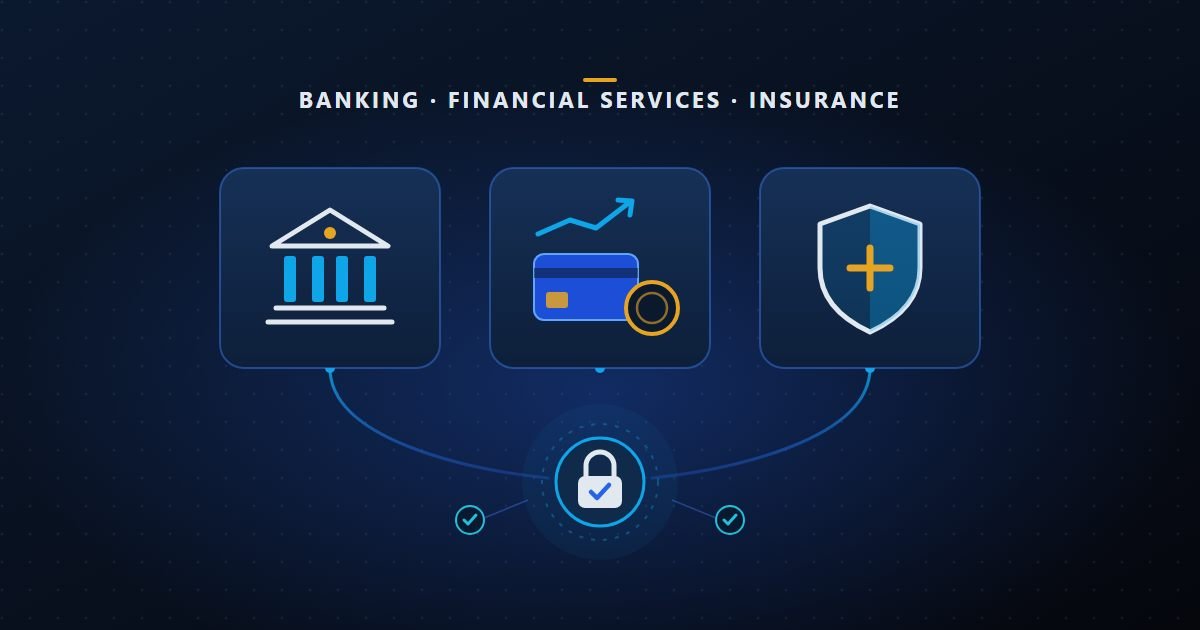
BFSI stands for Banking, Financial Services and Insurance — the umbrella term for the industry that holds, lends, moves, invests and protects money. It groups banks, NBFCs, fintechs, payment companies, wealth managers and insurers, which share heavy regulation, sensitive customer data and document-heavy operations.
This guide is written by Infusion Business Intelligence, a BPO and KPO provider that runs dedicated back-office and customer-support pods for BFSI clients from India. It explains the full form, what each of the three sectors includes, why the label is so common in India and in the IT and BPO industry, and what BFSI outsourcing actually covers — including the parts that should never be outsourced.
1. BFSI Full Form and Meaning
B
Banking
Deposits, loans, cards and payments
FS
Financial Services
NBFCs, fintech, lending, payments, wealth
I
Insurance
Life, health and general insurance
Whether you search for the BFSI full form, the "BFSI sector full form" or what BFSI means in banking, the answer is the same: Banking, Financial Services and Insurance. BFSI is not a legal category or a regulatory licence. It is an industry label used by companies, recruiters, analysts and technology and outsourcing providers to group businesses whose core product is money, credit or protection against financial risk.
The three parts are grouped because they behave alike operationally. All of them onboard customers against identity checks, process large volumes of documents, answer a steady stream of account or policy queries, and work under regulators that expect clear records and strong data protection.
2. The Three Sectors of BFSI Explained
Each sector has its own products, but the day-to-day work splits the same way: customer-facing processes that talk to account holders or policyholders, and back-office processes that keep records, files and checks accurate.
Banking
Institutions that accept deposits and lend. In India this includes public and private sector banks, small finance banks, cooperative banks and payments banks; elsewhere, retail, commercial and digital banks.
Customer-facing
Account opening and onboarding, card and account servicing, transaction and dispute queries, loan enquiries.
Back-office
KYC and re-KYC document checks, loan application data entry and file preparation, account maintenance, record updates and reconciliation.
Financial Services
The broadest of the three: NBFCs that lend without a banking licence (consumer, vehicle, gold, microfinance and housing finance), fintech and digital lenders, payment companies and wallets, brokerages, mutual funds and wealth managers.
Customer-facing
Loan application support, EMI and repayment queries, collections reminders, onboarding calls, payment and wallet support.
Back-office
Borrower document verification, underwriting file preparation, payment and settlement data operations, investor and customer record updates.
Insurance
Life insurers, general insurers (health, motor, property, travel) and reinsurers, plus the brokers and insurtech platforms that distribute policies.
Customer-facing
Policy enquiries, renewals and endorsements, claim intimation and claim status updates.
Back-office
Policyholder KYC, proposal form data entry, claims document collection and checking, policy administration records.
3. Why the BFSI Label Is So Common in India and in IT/BPO
In India the three sectors overlap in daily business. Banks sell insurance policies through bancassurance tie-ups, NBFCs and fintechs partner with banks on lending and payments, and large financial groups run banking, lending, broking and insurance companies under one brand. Treating them as one industry reflects how the market actually works.
The label is also a hiring and sales vertical. Job portals and recruiters use "BFSI" for roles in loans, cards, insurance and operations. IT services companies and BPO providers organise their delivery and sales teams by industry vertical, and BFSI is a standard one because its sub-sectors share the same needs: strict data security, heavy documentation, audit readiness and high-volume customer servicing.
So when a company says it has a "BFSI practice", or a provider advertises "BFSI BPO" services, it means a team trained for financial-sector processes and compliance expectations — not a different kind of outsourcing.
4. What BFSI Outsourcing Covers
BFSI outsourcing (often called BFSI BPO) means a bank, NBFC, fintech or insurer handing defined, repeatable operational processes to an external provider, who staffs and runs them inside the institution's own systems, rules and oversight. The most common scopes are:
Account & Policy Servicing (CX)
Answering account status, transaction, registration, renewal and policy queries across phone, email and chat.
Collections Support
Repayment reminders and follow-up calls run on the lender's approved scripts and within the conduct rules that apply to it.
KYC & Document Verification
Checking identity proofs, address proofs, bank statements and tax documents against the institution's checklist.
Underwriting Support
Collecting documents, verifying income and records, and compiling complete files for the institution's underwriters.
Claims Document Processing
Collecting and checking claim documents so the insurer's claims team receives a complete file.
Back-Office Data Operations
Loan and account data entry, record updates, data cleaning and reconciliation support.
The first two are classic BPO work. KYC checks, underwriting file preparation and claims document work lean towards KPO, because the people doing them need domain training rather than typing speed. For a closer look at why these two functions are moving to specialist teams, read why underwriting and KYC are moving offshore.
5. Regulation and Data Security in BFSI Outsourcing
BFSI is one of the most closely regulated industries in every market. In India, the Reserve Bank of India (RBI) regulates banks, most NBFCs and payment systems; the Insurance Regulatory and Development Authority of India (IRDAI) regulates insurers; and SEBI regulates the securities market. Other countries have their own banking, insurance and markets regulators.
Regulators such as the RBI and IRDAI publish rules on how regulated entities may outsource activities, and those rules generally keep the institution accountable for work done on its behalf. Customer data is also covered by data protection law — in India, the Digital Personal Data Protection Act, 2023; for EU residents' data, the GDPR. The practical takeaway: your compliance team should map any outsourcing arrangement against the rules that apply to your institution. A vendor cannot do that for you, and should not claim to.
Controls to expect from any BFSI outsourcing partner
An NDA and SLA signed before any data transfer; work done only inside your systems through role-based logins; no customer data stored on local machines; clean-desk rules on the floor; background-verified staff; logged activity you can audit; a documented incident and corrective-action process; and written terms for returning or deleting your data when the engagement ends.
6. What Stays with the Institution
Decisions are not outsourced
A BFSI outsourcing partner prepares, verifies and services. Credit and lending approvals, claim approval and settlement decisions, licensed financial or insurance advice to customers, and accountability to the regulator all remain with the bank, NBFC or insurer.
This boundary is what makes outsourcing work in a regulated business. The provider makes sure an underwriter receives a complete, verified file, or that a claims handler has every document they need; the institution's own people make the call. Be wary of any provider that offers to take on the decision itself.
7. Checklist: Choosing a BFSI Outsourcing Partner
Use these questions in your evaluation calls. A credible partner will answer each one in writing.
Domain-trained staff. Can they show how their team handles KYC checklists, underwriting file preparation or claims documents, rather than generic data entry?
Verifiable security. Ask for their access model, storage rules and audit trail, and check that certification status is stated accurately ("aligned" and "certified" are not the same).
Your systems, not theirs. Will the team work inside your loan management system, CRM or portals, with no data kept on their own machines?
Written scope and exclusions. Is it clear what the team does, and what it will never do, such as making credit or claim decisions?
Dedicated people. Is the team dedicated to your program, or shared across clients?
Quality and governance. How are accuracy and compliance scored, how often do you get reports, and what happens when an error is found?
A measured pilot. Can you start small with success metrics agreed before go-live?
Clean exit terms. Are SOP handover, access revocation and data return or deletion written into the agreement?
If you are weighing whether to outsource at all, our in-house vs. outsourced underwriting comparison sets the two models side by side.
8. How Infusion BI Works with BFSI Clients
We support banks, NBFCs, fintechs and lenders with KYC and document verification, underwriting support (collecting documents, verifying borrower income and records, and compiling complete credit files for your analysts and underwriters), loan and account data entry, and omnichannel customer support for transaction, account status and registration queries. For insurance clients we handle claim document verification and policyholder KYC collection.
Every program starts with one small dedicated pod — verification and KYC specialists, CX agents where support is in scope, a team lead and a QA analyst — sized in the SOW to your agreed volume and never shared with other clients. The pod works inside your loan management system, CRM or web portals through role-based logins, under clean-desk rules, zero local storage and ISO 27001-aligned controls (certification in progress). The NDA and SLA are signed before any data is transferred. The pod prepares and verifies files; credit and lending decisions always stay with your underwriters.
Scope
A written pilot SOW with 3–5 success metrics agreed before go-live; NDA and SLA signed.
Onboard & Deliver
2–4 weeks of onboarding and agent certification, then live delivery with daily reports and weekly governance reviews.
Review
At the end of the standard 3-month initial term you decide to scale, adjust or exit.
For an example of how secure back-office verification pods are set up and run for lenders, see the BFSI customer verification case study. Explore our BFSI outsourcing services, the Data Operations & Back-Office service, and our security & compliance controls.
Start with one workflow, measured against metrics you set.
Pick a KYC, underwriting support or account servicing workflow, agree the success metrics, and review the results at the end of the initial term. No obligation to renew.