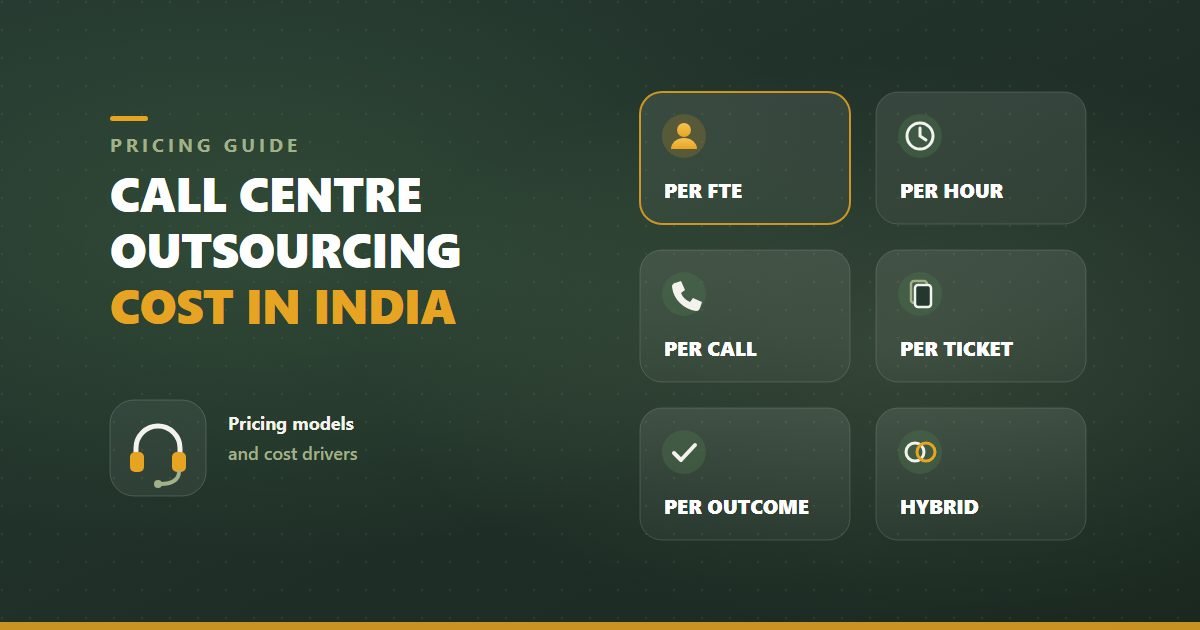
There is no single price for call centre outsourcing in India. Vendors charge per dedicated agent (FTE) per month, per productive hour, per call or minute, per ticket, or per outcome such as a booked appointment. What you pay depends mainly on language, shift coverage, channel, process complexity, volume and compliance requirements.
That answer frustrates buyers who want a number, so this guide gives you the next best thing: a clear map of how pricing works. It explains each pricing model and when it fits, the nine factors that move a quote up or down, the costs an in-house team carries that never appear on a salary sheet, and a method for comparing proposals so that a low headline rate does not hide a higher total. We do not quote market rates here, because a published rate without your volumes, hours and service levels behind it is more likely to mislead than help. When you have your own figures, the outsourcing TCO calculator turns them into a side-by-side annual cost.
1. The Six Call Centre Pricing Models
Almost every call centre or BPO quote in India is built from one of six models, or a mix of them. The model matters as much as the rate, because it decides who carries the risk when volume rises, falls or becomes unpredictable.
| Model | You pay for | Best for | Watch out for |
|---|---|---|---|
| Per FTE (dedicated agent) | A fixed monthly fee for each full-time agent assigned only to you | Steady, ongoing programmes; complex products; teams working inside your CRM | Idle time in quiet periods; whether leads, QA and tools are included |
| Per hour | Productive or logged-in agent hours | Part-time coverage, overflow, after-hours shifts | How "billable" hours are defined and audited |
| Per call / per minute | Each handled call, or each minute of talk time | Low or unpredictable inbound volume; simple, scripted calls | Incentive to rush calls (per call) or stretch them (per minute) |
| Per transaction / ticket | Each email, chat, ticket or back-office item completed | Measurable, repeatable digital work | What counts as "complete"; reopened tickets |
| Per outcome | A result: a qualified lead, a booked appointment, a sale | Short, well-defined sales campaigns | Quality of outcomes; disputes over what qualifies |
| Hybrid | A base fee (often per FTE) plus a variable or performance component | Programmes that want stability with shared upside | Complexity; make sure targets are within the vendor's control |
Per FTE: predictable cost, dedicated team
In a per-FTE (full-time equivalent) contract you pay a monthly fee for each agent who works only on your programme. The vendor carries recruitment, payroll, attrition and infrastructure; you get a stable team that learns your product and works your shifts. Because the agents are dedicated, they can be trained deeply and can work inside your own helpdesk or CRM. The trade-off is that you pay for the seat whether the phones ring or not, so per-FTE pricing suits steady or forecastable volume.
Per hour: flexible coverage
Hourly pricing bills only the hours agents work for you. It is common for overflow support, weekend or night cover, and seasonal peaks. Ask for a written definition of a billable hour: does it include breaks, training, team meetings and system downtime, and how will you verify it?
Per call or per minute: pay for what is handled
Transactional voice pricing ties your bill directly to volume, which is attractive when calls are few or spiky. It usually means agents are shared across several clients, so product depth is lower. Each variant also creates an incentive: per-call pricing rewards short calls, per-minute pricing rewards long ones. Pair it with quality measures such as first contact resolution so the incentive does not work against your customers.
Per transaction, per outcome and hybrid
Per-transaction pricing works for email, chat and back-office queues where each item has a clear start and finish. Outcome-based pricing pays for a result, such as a qualified lead or a booked appointment, and is most common in outbound sales. Hybrid models combine a fixed base with a variable element. In our experience, the hybrid and outcome models only work when the outcome is defined in writing before launch and is genuinely within the team's control.
2. What Drives the Price of an Outsourced Call Centre
Two vendors can quote very different figures for what looks like the same job. The difference almost always traces back to these nine factors. Knowing them lets you see which parts of a quote you can change, and which are fixed by what your customers need.
1. Language and accent requirements
English-only programmes draw on the largest talent pool. Regional Indian languages, multilingual cover, or a specific neutral accent for US, UK or Australian customers narrow the pool and raise hiring and training effort.
2. Hours and shift coverage
Business-hours cover in India is the simplest to staff. Night shifts aligned to US or UK time zones, weekend rosters and 24/7/365 coverage need more agents in total, shift allowances, transport and extra supervision.
3. Channel mix
Voice, email, live chat, WhatsApp and social channels have different handling times and concurrency. A chat agent can often run more than one conversation at a time; a voice agent handles one call. The mix changes how many agents you need.
4. Process complexity and training
A scripted order-status line is very different from L2 technical support or a regulated financial product. Complex work needs more experienced agents, longer training before go-live and a higher ratio of team leads and QA.
5. Volume and seasonality
Steady, forecastable volume can be served by a right-sized dedicated team. Sharp seasonal peaks need either spare capacity, which costs money when idle, or a flexible model that bills by hour or transaction.
6. Tooling and technology
Dialers, helpdesk and CRM licences, call recording, workforce management and QA software all cost money. Check whether agents work in your systems on your licences, or in the vendor's stack at the vendor's cost.
7. Compliance and data security
Programmes that handle financial, insurance or health data need clean-desk floors, restricted devices, access controls, audits and specific training. Those controls are worth paying for, but they belong in the price.
8. Location tier
Delivery from a metro hub and from a Tier-II city carry different salary levels, real-estate costs and attrition patterns. Location affects price, but so do the depth of the local talent pool and the stability of the team.
9. Attrition
Every agent who leaves must be replaced, recruited and trained, and a new agent takes weeks to reach full productivity. A vendor with lower attrition keeps experienced agents on your programme and spends less on rehiring.
The biggest lever is usually coverage, not rate
Moving from business hours to 24/7 can multiply the number of agents you need far more than any difference in vendor rates. Decide the hours, languages and channels your customers actually need before you compare prices.
3. How Much Do Appointment Setting Services Cost?
Outbound appointment setting, where sales development representatives (SDRs) research prospects, make calls and send emails, and book qualified meetings for your sales team, is priced in one of two main ways:
- Per dedicated SDR per month. You pay for a team that works only on your campaign. Cost is predictable, the SDRs learn your product and ideal customer profile (ICP), and quality standards are set by you.
- Per booked meeting or per lead. You pay only for results. This shifts risk to the vendor, but it can reward volume over fit: a meeting with a prospect who will never buy still counts unless your contract says otherwise.
Some providers combine the two with a base fee and a bonus per qualified appointment. Whichever model you are offered, the cost of a meeting depends on how hard your buyers are to reach, how tightly you define a qualified meeting (for example, against BANT: budget, authority, need and timing), the length of your sales cycle and the quality of the prospect data.
In our view, the most useful question is not "what does a meeting cost?" but "what does a meeting that turns into pipeline cost?" Ask any vendor how they qualify, who checks the meeting before it reaches your calendar, and what happens to meetings that do not show up or do not fit. Infusion BI's appointment setting service runs on dedicated SDR pods staffed per FTE, as part of our wider Sales as a Service offering; we do not offer pay-per-meeting or pay-per-lead-only pricing.
4. The Hidden Costs of an In-House Call Centre
The usual mistake when weighing the cost to hire a call centre is to compare a vendor's monthly fee with an agent's monthly salary. The vendor's fee includes far more than salary, so the fair comparison is with the fully loaded cost of running the same team yourself:
Statutory contributions and benefits
Employer social-security contributions, gratuity, leave, insurance and shift or transport allowances on top of gross pay.
Recruitment
Job advertising, agency fees, assessments and recruiter time for every hire, including replacements.
Training and ramp-up
Classroom training, nesting periods and the weeks before a new agent reaches full productivity.
Attrition
Repeating recruitment and training each time an agent leaves, plus the dip in service while the seat is empty.
Supervision and quality
Team leads, QA analysts, a workforce planner and trainers, none of whom take calls themselves.
Workspace, IT and continuity
Seats, hardware, connectivity, power backup, security, and licences for dialers, helpdesk and QA tools.
Labour law changes add to the in-house calculation
If you plan to build a team in India yourself, factor in the new labour framework. According to the Press Information Bureau release "Four Labour Codes Herald Transformational Change" (Ministry of Labour and Employment, 21 November 2025), the Code on Wages, the Industrial Relations Code, the Code on Social Security and the Occupational Safety, Health and Working Conditions Code were made effective from 21 November 2025, rationalising 29 existing labour laws. The same release says fixed-term employees become eligible for gratuity after one year instead of five, that IT and ITES workers' salaries must be released by the 7th of every month, and that women may work night shifts in all establishments, subject to their consent and required safety measures.
None of these rules is a reason to avoid hiring in-house, but each one belongs in an honest cost model: night-shift rosters need safety and transport arrangements, and contract structures change your gratuity exposure. An outsourcing partner carries these obligations for its own employees, which is part of what its fee pays for. Take advice on how the codes apply to your own business.
To put numbers on all of this, use the outsourcing TCO calculator: enter your salaries, overhead, attrition, ramp time, team leads, QA, tooling and workspace, and compare them with a vendor's per-FTE price. Every formula is explained on the page. For a qualitative view of the trade-offs, read our in-house vs outsourcing comparison.
5. How to Compare Call Centre Outsourcing Quotes
Quotes from different BPOs are rarely built on the same assumptions. Before you compare prices, make the proposals comparable. These steps work whether the quotes are per FTE, per hour or per transaction.
Send every vendor the same brief
Share monthly contact volumes by channel, average handle time if you know it, hours and days of cover, languages, and your service-level targets (for example, response time and first contact resolution).
Convert everything to one unit
Translate each quote into an estimated monthly and annual cost for your expected volume. A low per-minute rate can cost more than a per-FTE team once your real talk time is applied.
List what is included
Team leads, QA analysts, trainers, account management, tools and licences, reporting, recruitment and replacement of leavers. A quote that excludes them will look cheaper than it is.
Check one-time and variable charges
Set-up and onboarding fees, training for new processes, minimum volumes or seat commitments, overtime and holiday rates, and charges for changes in scope.
Compare quality commitments, not just price
Ask how quality is scored, how often interactions are sampled, what reports you receive and what happens when a target is missed.
Read the term and exit clauses
Initial term length, notice period, renewal rules, and what is returned to you on exit: your SOPs, knowledge base, reports and data.
A rate well below the others usually means something is missing: shared rather than dedicated agents, no QA layer, thin training, or costs that reappear as extras later. Ask the vendor to explain exactly how the price is built before you treat it as a saving.
6. Buyer's Checklist: Before You Sign
Use these questions with any call centre or BPO in India. Clear, written answers are a good sign in themselves.
Pricing Checklist
7. How Infusion BI Prices Outsourced Teams
Infusion Business Intelligence delivers customer experience, Sales as a Service and Data Operations from New Delhi and Haldwani. We price per dedicated FTE per month or on a volume basis, quoted after a scoping call, so you will not find a rate card on our website. A quote depends on the drivers above, and we would rather build it from your volumes than publish a number that does not fit your programme.
- Dedicated pod: every programme starts with one small dedicated pod, agents plus a team lead and a QA analyst, sized in the SOW to the agreed volume. Headcount is never shared with other clients.
- Pilot as the initial term: the pilot is our standard 3-month initial term, not a separate free trial. A written pilot SOW sets 3 to 5 success metrics before go-live.
- Security first: NDA and SLA are signed before any data transfer, and controls are ISO 27001-aligned (certification in progress).
- Onboarding: 2 to 4 weeks for customer experience and Data Operations pods, and 3 to 4 weeks for an SDR squad.
- Governance: daily performance reports, weekly governance reviews and monthly business reviews.
- Exit: no obligation to renew after the initial term. On exit, your SOPs, knowledge base and reports are handed back, access is revoked and your data is returned or deleted per the agreement.
- SDR pricing: SDR pods are staffed per FTE; we do not offer pay-per-meeting or pay-per-lead-only pricing.
Our customer experience outsourcing pods handle inbound and outbound voice, live chat, email and WhatsApp inside your own helpdesk or CRM, with 24/7/365 coverage options. If you want a figure for your own programme, the fastest route is a short scoping conversation through our contact page, or a pilot request.
Get a Quote Built on Your Numbers
Test a dedicated pod on a 3-month pilot
Tell us your volumes, hours and channels. We scope the pod, agree 3 to 5 success metrics in a written SOW, and review at the end of the term to scale, adjust or exit.
Frequently Asked Questions
Conclusion
How much outsourcing customer service costs in India comes down to two decisions: the pricing model and the scope. Per-FTE pricing buys a predictable, dedicated team; hourly, per-call and per-transaction pricing follow your volume; outcome and hybrid models share risk but need tight definitions. Within any model, language, coverage hours, channel mix, complexity, volume, tooling, compliance, location and attrition decide the final number.
Compare vendors on the same brief, convert every quote to an annual cost, and set that against the fully loaded cost of doing the work yourself. Start with the TCO calculator, and when you are ready to see real figures for your programme, request a pilot or contact our team.
Sources
Accessed on October 30, 2026. Pricing models and cost drivers are described from Infusion BI's own delivery experience; no market rates are quoted.
- Four Labour Codes Herald Transformational Change: Better Wages, Safety, Social Security & Enhanced Welfare for India’s Workforce (press release, November 21, 2025). Press Information Bureau, Ministry of Labour and Employment, Government of India. pib.gov.in