Affiliate disclosure: This article contains an affiliate link. If you choose to use it, Infusion Business Intelligence may receive a commission or other benefit at no additional cost to you.
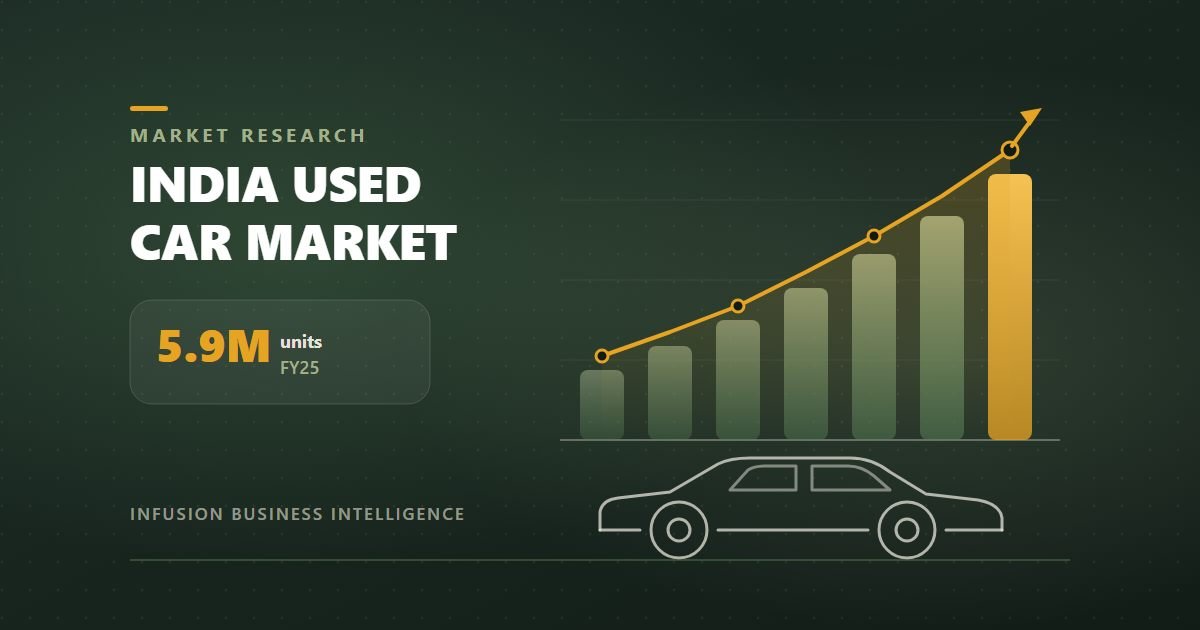
India's used car market recorded about 5.9 million sales in FY2024–25 and is projected to reach 9.5 million units by 2030, a growth rate of about 10% a year, according to the Indian Blue Book FY25 report. India already sells roughly 1.4 used cars for every new car, and buyers are steadily shifting from informal dealers to organised platforms.
This report brings together the most recent published research on the Indian second-hand car market: how large it is, why it is growing, how much of it is still unorganised, and what those trends mean in practice for the people on either side of a sale. Every figure below is attributed to its source in the text, and the full source list is at the end. If you are ready to sell and want the practical process instead, read our step-by-step guide to selling a used car online in India.
India's Used Car Market: The Key Numbers
5.9 million
Used cars sold in India in FY2024–25
Source: Indian Blue Book FY25 report, Mahindra First Choice & Volkswagen India
9.5 million
Projected annual used car sales by 2030 (about 10% CAGR)
Source: Indian Blue Book FY25 report
USD 68–78 billion
Projected market value by FY31, from about USD 35 billion in FY26
Source: Redseer Strategy Consultants, via Autocar Professional (May 2026)
1.37 : 1
Used-to-new car sales ratio in India (FY25); 2.5 in the US, 4.0 in the UK
Source: Indian Blue Book FY25 report
~80%
Share of used car transactions still in unorganised channels
Source: Redseer, "Buying with Confidence" (April 2026)
~65%
Share of used car buyers who are first-time car owners
Source: Redseer, via Autocar India (May 2026)
How Big Is India's Used Car Market, and How Fast Is It Growing?
By volume: the seventh edition of the Indian Blue Book (IBB), published in November 2025 by Mahindra First Choice (car&bike) and Volkswagen India, reports that India's used car industry recorded 5.9 million unit sales in FY25. The report projects sales to rise to 9.5 million units a year by 2030, a compound annual growth rate (CAGR) of about 10%.
By value: the same IBB report estimates the market at USD 36.39 billion in 2025, nearly doubling to USD 73.52 billion by 2030. A separate study by Redseer Strategy Consultants, reported by Autocar Professional in May 2026, sizes India's used car market at around USD 35 billion and 6 million units in FY26, growing to USD 68–78 billion and 9–10 million units by FY31. Redseer expects this to make India the world's third-largest used car market by the end of the decade, after the US and China.
Used cars already outsell new cars in India
The Society of Indian Automobile Manufacturers (SIAM) reported record domestic passenger vehicle sales of 4.3 million units in FY2024–25 (as reported by ANI/ThePrint, April 2025). Set against the IBB's 5.9 million used car sales for the same year, that gives the ratio the IBB itself reports: India's used-to-new car ratio stood at 1.37 in FY25 and is on track to reach 1.9 by 2030. Mature markets run far higher, at 2.5 in the US, 2.6 in Germany, 3.0 in France and 4.0 in the UK, according to the same report. Redseer's analysis makes the same point, putting India at about 1.4x against 2–3x in mature markets.
In our reading, that gap is the strongest single argument for continued growth. The ratio is not a ceiling India is pressing against. It shows how much of the established pattern in older car markets India has yet to catch up with.
| Measure | Indian Blue Book FY25 report | Redseer (2026) |
|---|---|---|
| Current volume | 5.9 million units (FY25) | ~6 million units (FY26) |
| Projected volume | 9.5 million units (2030) | 9–10 million units (FY31) |
| Volume growth rate | ~10% CAGR | 8–11% CAGR |
| Current value | USD 36.39 billion (2025) | ~USD 35 billion (FY26) |
| Projected value | USD 73.52 billion (2030) | USD 68–78 billion (FY31) |
The two studies use different periods (calendar 2030 versus fiscal year 2031) and different methods, so the figures are not directly interchangeable. They agree on direction and rough scale: a market of about 6 million cars a year heading towards 9–10 million. You may also see a "10 million by 2030" headline in press coverage of the IBB report; the report itself projects 9.5 million.
What Is Driving the Growth of Second-Hand Car Sales?
Published research points to six forces behind the growth of India's used car market. Each is stated below with the source that supports it.
1. First-time car owners
Nearly 65% of people buying a used car in India are first-time car owners, according to Redseer's 2026 study (reported by Autocar India). For many households, a used car is the first step into car ownership.
2. Shorter replacement cycles
Owners are keeping cars for less time. Redseer reports the average holding period fell from 7–8 years in FY21 to 5–6 years in FY26, and expects it to shrink to 4–5 years by FY31 (Autocar Professional, May 2026). Faster replacement puts more, and younger, cars into the used supply.
3. The shift to SUVs and pricier cars
SUVs and compact SUVs make up more than half of India's used car market, up from 23% four years earlier, according to the Indian Blue Book FY25 report. The report puts the average used car selling price at about Rs 5.45 lakh in FY25, a 36% increase over FY21. The same trend shows in new cars: utility vehicles were 65% of new passenger vehicle sales in FY2024–25, per SIAM data reported by ThePrint.
4. Demand beyond the metros
The Indian Blue Book FY25 report identifies non-metro buyers as the fastest-growing segment, with 68% saying they are likely to buy a used car again. It credits digital access (954 million internet subscribers, including about 400 million in rural India) with helping Tier-II and Tier-III cities emerge as growth engines.
5. Easier financing
Used car loans are becoming more common. The Indian Blue Book FY25 report says used car financing penetration grew from 15% in 2010 to over 25% in 2024. Redseer estimates penetration at 20–30% in FY22, rising to 30–40% by FY27 (Autocar Professional). The two estimates use different bases, but both show more buyers borrowing to buy used.
6. Organised and digital channels
Organised players, meaning online platforms, OEM certified pre-owned programmes and branded dealers, are growing their share. The IBB press release notes that dealers are using more procurement channels, with exchanges at new car dealerships and OEMs becoming key sources of used inventory. AI tools are still early: only 6% of purchases involve them, per the same release.
Organised vs Unorganised: The Trust Gap in Used Car Sales
Most second-hand cars in India still change hands through neighbourhood dealers, brokers and private sales. The Indian Blue Book FY25 report finds the organised share of transactions rose from 18% in FY23 to 21% in FY25, while semi-organised networks slipped from 11% to 10%. Redseer's April 2026 report, "Buying with Confidence: Bridging the Trust Deficit in India's USD 70 Bn Used-cars Market", states that nearly 80% of transactions are unorganised and that transactions involve multiple intermediaries, about 2.1 touchpoints on average.
Redseer calls the result a "trust deficit": buyers cannot easily verify a car's condition or history, and sellers cannot easily verify a fair price. According to Autocar India's coverage of the same study, organised players could account for nearly 30% of the market by FY31. Consumer sentiment points the same way. The IBB press release reports that over 70% of customers believe organised dealers provide superior service, and Redseer (via Autocar Professional) measures a net promoter score of around 80% for full-stack platforms, against less than 30% for unorganised channels.
The trust gap is a cost to both sides. Sellers who cannot prove a car's condition tend to accept lower offers, and buyers who cannot verify it either overpay or walk away. Organised channels grow because they turn condition, price and paperwork into something both parties can check.
How the Shift Helps Used Car Sellers
For people selling a second-hand car, a larger and more organised market changes four practical things. These points describe how organised channels generally work; terms differ between buyers, so confirm them for any offer you receive.
- Price discovery: online valuation tools let a seller see an indicative price range before talking to any buyer, which makes a low first offer from a local dealer easier to spot.
- Inspection-based offers: organised buyers usually inspect the car and price it on recorded condition. The final offer can be lower than the online estimate, but the reasons are written down rather than argued on the spot.
- Payment security: a traceable bank transfer before handover replaces cheques and staged cash payments, the most common source of disputes in private sales.
- RTO transfer handling: until the Regional Transport Office (RTO) records the new owner, the seller stays the registered owner. Organised buyers typically file the transfer forms themselves, which reduces the risk of challans or liability landing on the seller after the sale.
Rising average prices also help sellers in a simple way. With the Indian Blue Book reporting a 36% rise in average used car selling prices between FY21 and FY25, and with demand for SUVs strong, a well-kept car often holds its value better than owners expect. The documents and steps for a sale are covered in detail in our guide on how to sell your car online, from valuation to RTO transfer, and if you are still choosing where to sell, see our comparison of online used car marketplaces in India.
See what your car could be worth before you talk to a dealer
Spinny is one of the organised platforms that buys used cars directly from owners. You can enter your car's details on its sell-car page to start the process online.
Get a Valuation on SpinnyHow the Shift Helps Used Car Buyers
The same changes reduce risk for people buying a second-hand car in India, which matters most for the first-time owners who, per Redseer, make up nearly two-thirds of used car buyers.
Inspected, documented cars
Full-stack platforms run multi-point inspections, often 180+ checkpoints, with documentation and a history report, according to the Indian Blue Book FY25 report. That gives buyers a written condition record instead of a seller's word.
Warranties buyers ask for
66% of customers value a warranty as the most important add-on service, per the IBB press release. Warranty terms vary by seller, so read what is covered and for how long before you pay.
Access to financing
With used car financing penetration above 25% in 2024 (IBB FY25 report), and platforms partnering with banks and NBFCs on used car loans, more buyers can spread the cost of a better car.
Wider, younger choice
Shorter holding periods (Redseer) and growing exchange and OEM sourcing (IBB press release) mean more recent models reach the used market, including the SUVs buyers now prefer.
The trade-off for buyers is price. Organised, inspected cars usually cost more than an unverified private sale, and the IBB's rising average selling price reflects buyers paying for newer, larger cars. In our view, the inspection report, the ownership history on the Registration Certificate (RC) and the written warranty terms are worth comparing before price alone.
Outlook: India's Used Car Market to 2030–31
Both major studies expect India's used car market to keep outgrowing new car sales through the end of the decade. The published ranges to keep in mind:
- Volume: 9.5 million units by 2030 (Indian Blue Book FY25 report) or 9–10 million units by FY31 (Redseer).
- Value: USD 73.52 billion by 2030 (IBB) or USD 68–78 billion by FY31 (Redseer).
- Used-to-new ratio: from 1.37 in FY25 to 1.9 by 2030 (IBB).
- Average selling price: from around Rs 5 lakh in FY26 to Rs 6.5–6.9 lakh by FY31 (Redseer, via Autocar Professional).
- Organised share: nearly 30% of the market by FY31 (Redseer, via Autocar India), up from 21% organised in FY25 (IBB).
These are projections, not certainties. Both reports note risks: the IBB report's own disclaimer flags regulatory changes, market volatility and new technology as factors that may alter outcomes. What the data supports with more confidence is the direction: more cars, more first-time owners, and a steady move towards channels that can prove a car's condition and handle its paperwork.
Prefer we connect you?
Tell us whether you want to sell or buy a used car. Our team will call you and connect you with a car-buying partner. There is no charge for this.
Enquiry received
Thank you. Our team will call you on the number you gave us.
Frequently Asked Questions
Conclusion
India's used car market is large, growing and changing shape. About 5.9 million second-hand cars were sold in FY25, the market already outsells new cars, and independent studies from the Indian Blue Book and Redseer both project 9–10 million annual sales by 2030–31. The biggest change is not size but structure: buyers and sellers are moving towards channels that can prove a car's condition, pay securely and complete the RTO transfer.
For sellers, that means better price discovery and less post-sale risk. For buyers, especially first-time owners, it means inspected cars, warranties and easier financing. If you are selling, you can get an online valuation for your car on Spinny, or send us an enquiry and Infusion Business Intelligence will connect you with a car-buying partner.
Sources
All sources accessed on October 29, 2026.
- Indian Blue Book Report FY 2024-25 (Annual Report 2024-25). Mahindra First Choice (car&bike) and Volkswagen India. Covers FY25 data and projections to 2030. volkswagen.co.in (PDF)
- India’s Used Car Market Races Past 5.9 Million, Set To Double and Hit 10 Million by 2030: Indian Blue Book Report FY’25 (press release, November 13, 2025). Volkswagen India. Note: the report body projects 9.5 million units by 2030. volkswagen.co.in
- Buying with Confidence: Bridging the Trust Deficit in India's USD 70 Bn Used-cars Market (April 30, 2026). Redseer Strategy Consultants. redseer.com
- India Used-Car Market To Hit $70 Bn By FY31: Redseer Report (May 15, 2026). Autocar Professional. Covers FY26 estimates and FY31 projections. autocarpro.in
- India To Become World's 3rd Largest Used Car Market By 2031: Redseer Report Decoded (video, May 18, 2026). Autocar Professional. Source of the 1.4x vs 2–3x used-to-new comparison. autocarpro.in
- India's used-car market to reach 10 million units by FY31: Redseer report (May 16, 2026). Autocar India. Source of the first-time buyer and FY31 organised-share figures. autocarindia.com
- India's passenger vehicle sales hit record high at 43 lakh units in FY24-25, utility vehicles driver of growth: SIAM (April 15, 2025). ThePrint (ANI), reporting Society of Indian Automobile Manufacturers data for FY2024-25. theprint.in