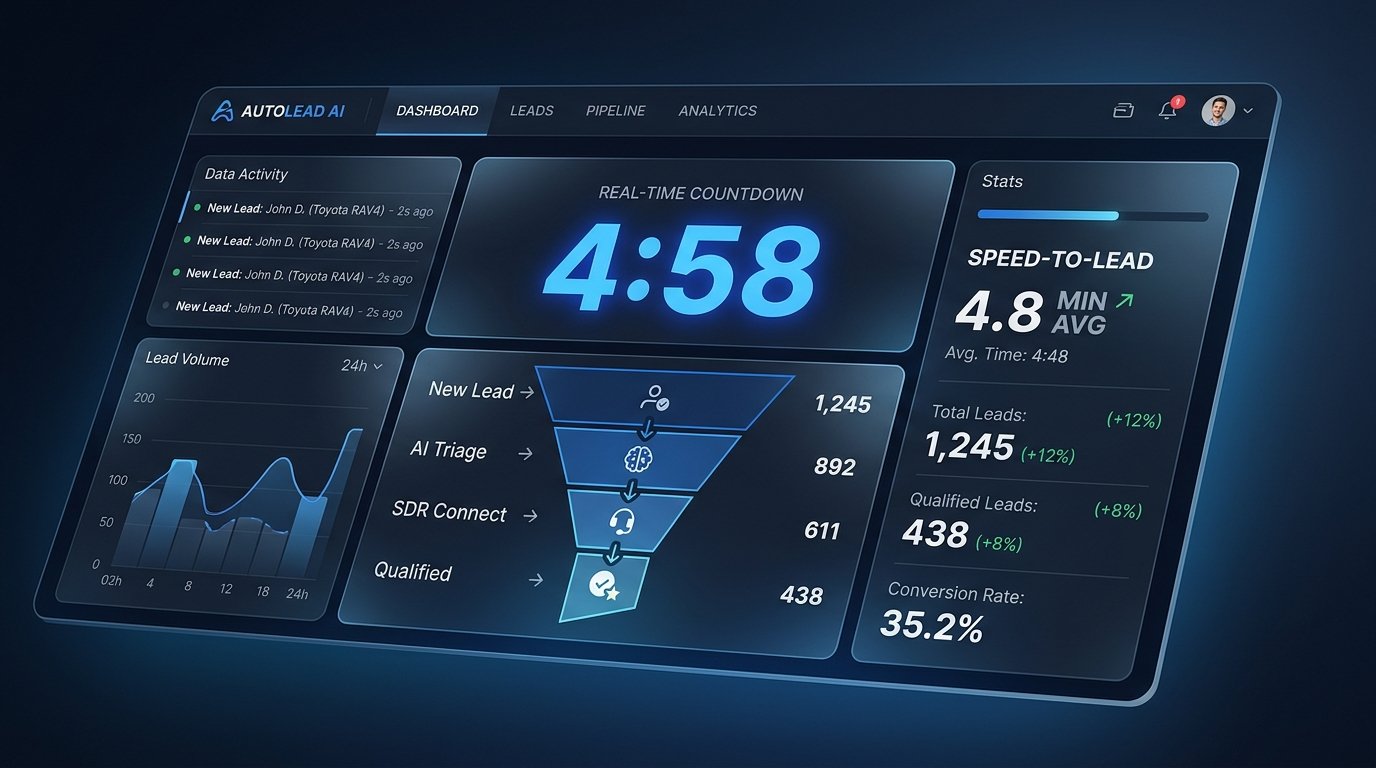
In the Indian AutoTech market — where platforms like Cars24 and Spinny process hundreds of high-intent vehicle enquiries every hour — enterprise sales teams live and die by a single number: the time between a buyer submitting a lead form and a qualified human picking up the phone.
That number is five minutes. And if your team is not hitting it consistently, you are not losing to a competitor's price or product. You are losing to a clock.
This post explores the mechanics behind the 5-Minute Rule, explains how AI predictive dialing and smart lead triage make it operationally achievable at enterprise scale, and demonstrates why the shift from traditional telemarketing to a full Sales as a Service model is the architectural decision separating AutoTech market leaders from the rest.
1. The 5-Minute Rule: What the Data Actually Says
Research published by James Oldroyd, Kristina McElheran, and David Elkington — cited in the Harvard Business Review — found that companies attempting to contact a web lead within one hour were seven times more likely to qualify that lead than those who waited even sixty minutes. When the response window narrows to five minutes, that multiplier reaches 21 times compared to a thirty-minute response (Source: Oldroyd et al., "The Short Life of Online Sales Leads," HBR, 2011).
Qualification Rate
21×
More likely to qualify at <5 min vs. 30 min
Source: Oldroyd et al., HBR 2011
Target Window
<5min
Benchmark for AutoTech high-intent inbound leads
Pipeline Impact
3X
Revenue Growth Accelerated for enterprise AutoTech programs
The intuition is straightforward. When a buyer submits a vehicle enquiry, their intent is at its absolute peak at that exact moment. They are on the platform, engaged, and mentally prepared for a conversation. Every minute that passes without a response is a minute they spend reconsidering, comparing alternatives, or simply moving on. A five-minute response catches them while that intent is still live.
"In AutoTech, the vehicle is the category. Intent is the window. Speed is the only competitive edge a sales operation can engineer — everything else is the product team's problem."
2. Why AutoTech Lead Management Is Fundamentally Different
AutoTech is not like BFSI or SaaS sales. The purchase decision is emotional and time-compressed. A buyer considering a vehicle — particularly in the high-velocity used-car segment dominated by platforms like Cars24 and Spinny — is operating on a decision timeline measured in hours, not weeks. They browse multiple listings simultaneously. They may submit enquiries to two or three competing platforms in the same session.
Compressed Decision Timelines
Vehicle purchases — especially in the used-car segment — follow an emotional arc that compresses the decision window to hours. A 30-minute response lag is not slow; it is commercial abandonment.
Multi-Platform Competition
High-intent buyers submit enquiries on multiple platforms simultaneously. Whichever platform's SDR reaches them first owns the conversation — and often the sale.
Lead Volume Volatility
AutoTech platforms experience sharp intraday lead surges — weekends, promotional windows, post-ad bursts. In-house teams cannot flex capacity in real-time. A specialist partner with bench capacity can.
The operational implication is direct: an enterprise AutoTech sales operation that relies on a manual inbound queue — where a team lead reviews lead forms, assigns them to SDRs, and expects callbacks within the hour — is not running a lead conversion function. It is running a lead disposal function. The economics of a missed 5-minute window compound across thousands of leads per month into a measurable, avoidable revenue gap.
3. AI Predictive Dialing & Smart Triage: Making 5 Minutes Operationally Possible
The reason most AutoTech operations fail the 5-Minute Rule is not a people problem — it is an architecture problem. Manual processes cannot classify, route, and connect at the speed the window demands. The solution is a three-layer AI triage architecture that removes human latency from the routing decision entirely.
Intent Scoring at Ingestion
The moment a lead form is submitted, AI analyses behavioural signals: vehicle price band, dwell time on the listing, number of photos viewed, repeat visit history, and time-of-day pattern. Within seconds, the lead is assigned a purchase-intent score. High-scoring leads bypass the queue entirely and are routed directly to the dialler.
Predictive Dialler Routing
High-intent leads are passed directly to a predictive dialler connected to a pre-positioned SDR pod. The dialler initiates the call and connects the agent the moment the buyer answers — eliminating 20–40 seconds of manual dialling latency per attempt. At scale across hundreds of simultaneous leads, this compression is commercially decisive.
Contextual SDR Briefing
Before the call connects, the SDR receives a live context card: vehicle of interest, price range, platform origin, and intent score. The first ten seconds of the call are not cold — they are warm, informed, and specific to that buyer's search. This dramatically increases the probability of a productive first interaction and a successful BANT qualification.
Key Operational Insight
The 5-Minute Rule is not about working faster — it is about removing architectural latency. Manual assignment queues, shift-change gaps, and reactive dialler scheduling are the structural enemies of speed-to-lead. AI triage eliminates these friction points by routing leads before a human even knows the lead arrived. At Infusion BI, this architecture delivers an average speed-to-lead of under five minutes across our AutoTech programs.
4. BANT Qualification: Stop Abandoning Leads, Start Building Pipeline
Speed-to-lead solves the contact problem. BANT qualification solves the pipeline quality problem. There is no point reaching a buyer in four minutes if the subsequent conversation produces a lead that your closing advisors spend three weeks chasing, only to discover it was a passive browser comparing prices.
BANT — Budget, Authority, Need, Timeline — is the qualification framework that separates a contacted lead from a pipeline-ready lead. In AutoTech, BANT qualification during the first SDR call typically filters 60–70% of raw lead volume as low-probability and routes the remaining 30–40% — the genuinely high-intent buyers — to dedicated closing advisors with a complete qualification profile attached.
| BANT Dimension | AutoTech SDR Question | Outcome Signal |
|---|---|---|
| Budget | What price range are you comfortable with? Are you considering vehicle financing? | Confirms deal viability; routes to finance team if applicable |
| Authority | Is the purchase decision yours alone, or is a family member or partner also involved? | Identifies influencer — closing call includes the right decision-maker |
| Need | Are you replacing a current vehicle or is this an additional purchase? | Urgency indicator; existing-vehicle replacement signals higher near-term intent |
| Timeline | Are you looking to complete the purchase this week, or over the next month? | <7 days = priority queue; beyond 30 days = nurture sequence |
The economic impact of consistent BANT qualification is substantial. When closing advisors receive only pre-qualified, high-intent leads — complete with a qualification profile, vehicle preference, and budget confirmation — their time-to-close compresses, their conversion rate rises, and the cost of each sale falls. This is the primary mechanism through which dedicated SDR pods drive 3X Revenue Growth Accelerated for enterprise AutoTech marketplaces.
5. Sales as a Service vs. Traditional Telemarketing: The Architecture Gap
Enterprise AutoTech leaders evaluating their sales operations often inherit a legacy model — a shared telemarketing pool with generic scripts, daily dialler lists, and monthly performance reviews. This model was never designed to hit a five-minute window. It was designed to make volume calls and report dials-per-day to a team manager.
Sales as a Service is a fundamentally different architecture — not a rebrand of the same model. The differences compound across every dimension of the operation:
| Dimension | Traditional Telemarketing | Infusion BI — Sales as a Service |
|---|---|---|
| Lead Assignment | Manual queue — team lead assigns | AI intent scoring routes in <30 seconds |
| Speed-to-Lead | 15–45 min (shift-dependent) | <5 min (predictive dialler + pre-positioned pod) |
| Agent Knowledge | Generic script across all vehicle types | Brand-trained, inventory-specific SDR pod |
| Qualification Method | Basic interest check | Structured BANT + full CRM profile created on call |
| Handoff to Close | Manual (often delayed, data-incomplete) | Instant CRM transfer with full qualification card |
| QA Coverage | 2–5% sample review | 100% AI call audit, daily CAPA-linked reporting |
| Surge Capacity | Hiring cycle (weeks) | Bench capacity — scaled within hours |
| Pipeline Visibility | Weekly summary report | Real-time BI dashboard + weekly governance pack |
The Hidden Cost of the Telemarketing Model
A shared telemarketing pool operating on a 30-minute average response window will not just lose individual leads — it will suppress the entire CAC economics of your AutoTech operation. When closing advisors receive unqualified, stale contacts, they spend time re-qualifying, chasing, and managing objections that a 5-minute BANT conversation would have resolved or eliminated. The real cost is not the lost lead — it is the cascading inefficiency it creates downstream in your closing team's productivity.
6. How Infusion Business Intelligence Delivers This for AutoTech Enterprises
Infusion Business Intelligence operates dedicated AutoTech SDR pods — teams trained specifically on vehicle category knowledge, marketplace dynamics, and buyer psychology in the Indian used-car and new-vehicle segments. These pods do not serve multiple clients from a shared queue. Each pod is aligned to a single client program with client-specific qualification criteria, scripts, and CRM integration.
<5 min
Avg. Speed-to-Lead
95%+
CSAT Score
3X
Revenue Growth Accelerated
The technology layer underneath these pods — AI intent scoring, predictive dialling, automated BANT capture in CRM, and 100% daily AI call audits — is not a future roadmap item. It is operational today, delivering consistent sub-five-minute speed-to-lead performance across high-volume AutoTech programs for clients including Cars24 and Spinny.
For Sales and Operations leaders evaluating their current vendor or building the internal case for a Sales as a Service transition, the relevant question is not "can we hit five minutes occasionally?" It is: "what is our median speed-to-lead across all leads, all days, all peak windows?" If that number exceeds five minutes on any consistent basis, there is a measurable, addressable revenue gap in your operation right now.
For AutoTech Sales Leaders
What is your current speed-to-lead average?
If you don't know the number, that is the first problem. Let us run a 4-week pilot — you will have the benchmark and a qualified pipeline improvement within the month.
Frequently Asked Questions
The 5-Minute Rule states that contacting a high-intent vehicle buyer within five minutes of a lead submission increases the probability of qualifying that lead by up to 21 times compared to a 30-minute response window (Source: Oldroyd et al., "The Short Life of Online Sales Leads," Harvard Business Review, 2011). In the Indian AutoTech market, where platforms like Cars24 and Spinny process hundreds of leads per hour, hitting this window consistently requires AI-powered triage and pre-positioned SDR capacity — not manual queue management.
AI predictive dialing analyses multiple data signals — page dwell time, vehicle category viewed, price band selected, and time-of-day patterns — to score each inbound lead for purchase intent. High-scoring leads are instantly routed to a live SDR within seconds of submission. Predictive dialers also sequence callback attempts algorithmically, ensuring the right call lands at the moment a buyer is most likely to answer. At Infusion BI, this system consistently delivers an average speed-to-lead of under five minutes across AutoTech programs.
BANT is a qualification framework covering Budget, Authority, Need, and Timeline. In AutoTech, BANT qualification during the first call determines whether a lead is a genuine near-term buyer or a passive browser — a distinction that can account for 60–70% of total lead volume. Filtering this distinction at the SDR stage ensures only high-probability leads advance to the closing conversation, dramatically improving close rates and reducing wasted follow-up effort.
Traditional telemarketing operates on volume: a large agent pool works through a dialler list with a generic script, and success is measured in calls made. Sales as a Service replaces that model with dedicated SDR pods trained on your specific vehicle inventory, buyer personas, and qualifying criteria. AI triage routes only high-intent leads to these specialists, BANT qualification filters the pipeline, and real-time CRM integration ensures every handoff to a closing advisor includes a complete buyer context profile — converting more leads with fewer agents.
Infusion Business Intelligence combines AI-powered lead scoring, predictive dialler technology, and dedicated AutoTech SDR pods to consistently achieve sub-five-minute contact times at scale. Our system classifies inbound leads by intent signal within seconds of submission, routes them to the appropriate specialist SDR, and records every interaction in the client's CRM in real time. For clients including Cars24 and Spinny, this architecture has delivered measurable improvements in lead conversion rates and pipeline velocity, contributing to 3X Revenue Growth Accelerated across partnered AutoTech programs.